
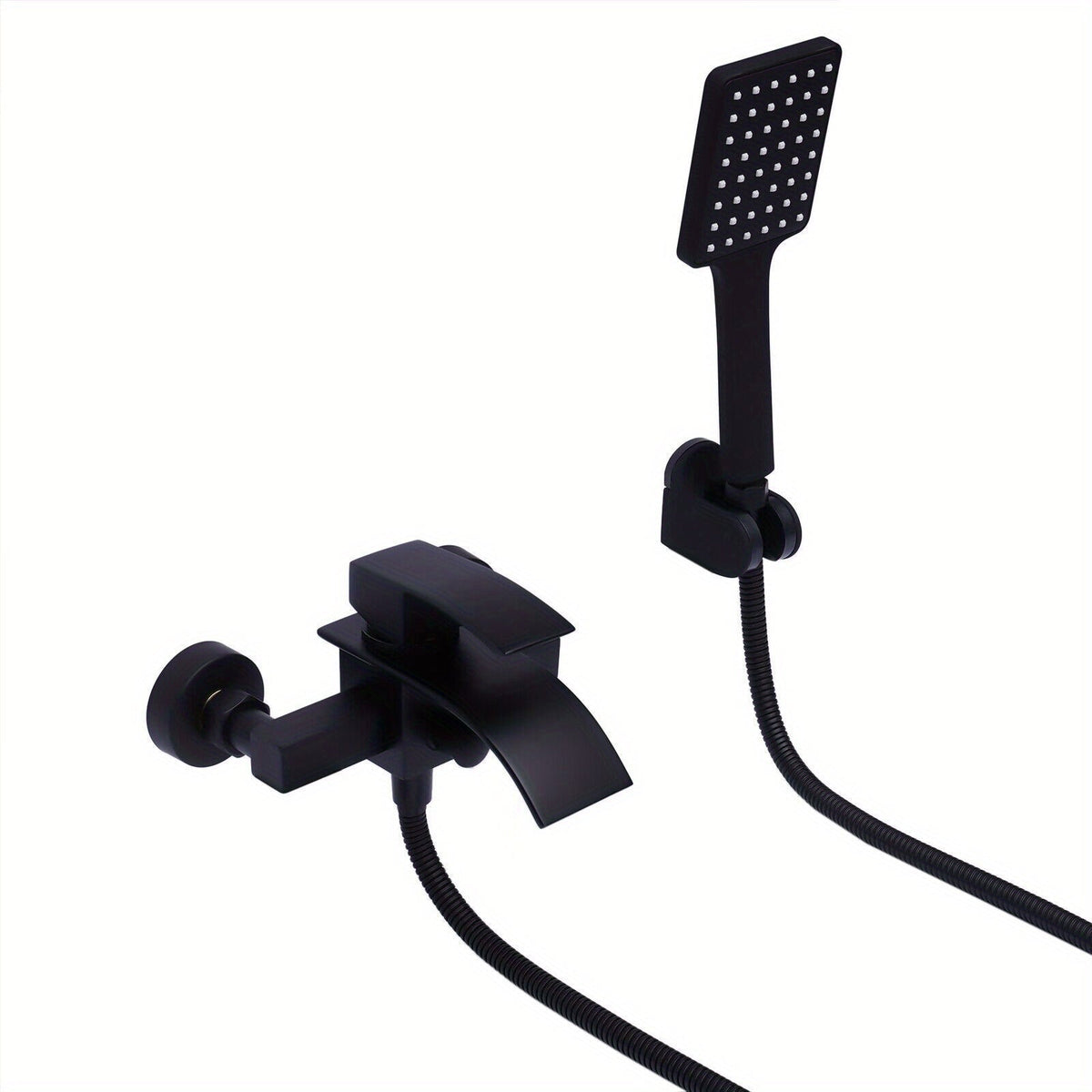
Replacing a wall-mounted shower mixer means turning off the water, unscrewing the two nuts that hold it onto its eccentric fittings, then screwing on the new one with new washers. The only real check is the centre distance, the distance between the two water supplies: in France, it is most often 15 cm, and the eccentric fittings make up a small difference. A wall-mounted bath tap is replaced in the same way.
The method is the same for a shower mixer and for a wall-mounted bath shower mixer. Allow a quiet afternoon the first time, with your tools out. Above a bath, a wall-mounted bath mixer fits onto the same fittings.
Before buying: measure the centres and check the connection
Measure, centre to centre, the distance between the middle of the hot water supply and that of the cold water supply. Our wall-mounted shower tap product pages point it out: the centre distance remains 15 cm, as almost everywhere in France. A mixer designed for 15 cm therefore fits most installations without touching the wall.
Some models state a range rather than a single value. The brushed stainless steel wall-mounted shower and bath tap (€89.90) accepts a drilling centre distance of 130 to 170 mm, with a 1/2 connection, and its product page specifies that it is sold without shower head or hose: allow for those if yours are worn.
Also check the thread. Of the ten active mixers in our shower mixer collection, nine state a 1/2 connection on their product page; the tenth does not specify it.
The tools and parts to have ready
- an adjustable or open-ended spanner, and a cloth to protect the chrome;
- water pump pliers to hold an eccentric fitting while tightening;
- sealing tape or hemp with paste, if you change the eccentric fittings;
- new washers for the mixer nuts and for the hose;
- a spirit level.
The steps to replace the mixer
1. Turn off the water and drain
Close the mains supply, or the bathroom valve if there is one. Run the shower, hot then cold, to empty what is left in the pipes and release the pressure.
2. Remove the old mixer
Unscrew the hose by hand. Wrap each nut in a cloth, then loosen them with the spanner while holding the body of the mixer so as not to force the eccentric fittings. Remove the mixer, collect the old washers and clean the threads of the eccentric fittings.
3. Keep or change the eccentric fittings
If the centres suit and the eccentric fittings are sound, keep them: that is what avoids touching the tiles. Just put them back true, at the same level and at the same depth. If they are seized, cracked or scaled up, unscrew them, wrap the threads of the new ones with tape or hemp, and screw them in until you get back the centres and the horizontal. An eccentric fitting turns on itself: it is this offset that makes up a centimetre or two of difference, as the product page of our shower column for bath mixer tap points out.
4. Fit the new mixer
Screw the cover plates onto the eccentric fittings. Place a new washer in each mixer nut, with its filter if one is supplied. Offer up the mixer, start both nuts by hand at the same time, then tighten with the spanner, without forcing: it is the washer that seals, not the crushing. Check the horizontal with the level.
5. Reconnect and test
Screw the hose back on with a new washer. Reopen the water slowly, run hot then cold, and put a dry piece of paper under each nut: it should stay dry after a few minutes.
If the handset is scaled up, take the opportunity to replace it: our anti-limescale shower heads come in chrome, black, white or gold.
Shower or bath: what changes
A wall-mounted bath mixer comes off in the same way. It also has a filler spout and a diverter between the spout and the handset: check that the spout projects far enough beyond the rim of your bath. It also goes lower than a shower mixer, above the rim; the fitting heights on the shower side are in our guide on the height of the shower mixer and shower head.
To replace a bath tap fitted on the rim or freestanding, the logic is different: it is fixed from underneath, on the bath deck. Wall-mounted and deck-mounted models are brought together in the bath tap collection.
The mistakes that make a new mixer leak
- Reusing the old washers: crushed, they do not regain their shape.
- Overtightening: a pinched washer leaks as much as a missing one, and a nut that is too tight can crack.
- Leaving the eccentric fittings at different depths: the mixer sits crooked and a nut does not bear on its washer.
- Putting tape on the mixer nut: the seal of this nut is made by the flat washer; the tape goes on the thread of the eccentric fittings.
- Forgetting to measure the centres before ordering.
Which mixer to choose to replace the old one
For a simple shower, the complete shower tap (€49.90) is a wall-mounted mixer with a 1/2 connection designed for the 15 cm centre distance. Other wall-mounted taps, thermostatic ones included, are in the shower tap collection.
If you are redoing the whole shower rather than just the mixer, our shower columns come in thermostatic versions, with mixer or without tapware.
And if the whole bathroom is changing, our taps for basin, countertop basin and bath come in waterfall, antique or traditional styles.
For a bath, the black shower mixer (€94.90) is a matt black wall-mounted bath shower mixer with a waterfall spout, with a 1/2 connection, shown in the photo with a handset on a holder.
If your mixer leaks without being beyond use, a simple cartridge may be enough: see our article on the leaking or dripping tap, and the signs of a faulty mixer tap.
The questions we get asked most
How do you change a shower tap without changing the eccentric fittings?
That is the most common case: if the centre distance of the new mixer matches and the eccentric fittings are in good condition, you only touch the nuts and washers. The tiles stay intact.
If the neighbouring basin deserves the same refresh, our chrome or vintage basin taps also come in matt black and in a wall-mounted version.
Where is the hot water on a mixer tap?
By convention, the hot water arrives on the left, marked red, and the cold water on the right. Still check your supplies before tightening: a reversed installation gives a mixer that heats the wrong way round.
The same convention applies at the basin: if you also change its tapware, our basin and countertop basin mixer taps range from the compact model to the waterfall spout.
What is the lifespan of a shower mixer?
It depends mainly on the cartridge and the limescale in your water. We explain it in our article on the lifespan of a mixer tap.
Can you replace a thermostatic mixer in the same way?
Yes: a wall-mounted thermostatic mixer fits onto the same eccentric fittings, with the same washers. Only the temperature setting changes in use.
