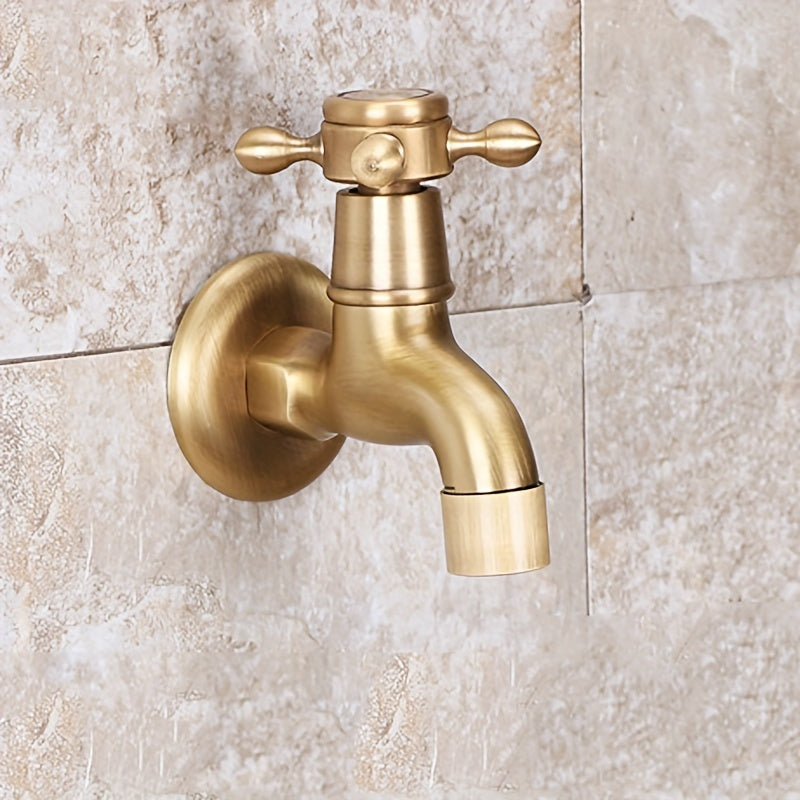
To clean a brass tap, first identify its finish, then wash it with a soft cloth and soapy lukewarm water, rinse with clean water and dry straight away. Diluted vinegar for limescale and bicarbonate paste for tarnish come only afterwards, always after a test on a hidden area, and bicarbonate on raw brass only.
What damages a brass tap is rarely the dirt. It is a product chosen without knowing what covers the metal: the action that revives bare brass stains a lacquer, scratches chrome and wipes off a patina applied on purpose.
Is your tap really bare brass?
Brass is an alloy of copper and zinc. It is often used for the body of a tap, but what you touch is not necessarily the brass itself. There are four cases.
- Raw or patinated brass. The metal is bare. It tarnishes, darkens, and sometimes gets greenish spots around the joints. This is the only case where a mildly abrasive cleaner is acceptable.
- Lacquered or plated brass. A clear lacquer or a layer of another metal protects the surface. When it wears, dark patches appear, where the hand touches most.
- Gold, bronze or aged brass finishes. The colour or antique effect comes from a surface treatment or paint. Rubbing it means removing it.
- Chrome, brushed nickel or black on a brass body. The surface is not brass: you are cleaning chrome, nickel or paint.
How do you know which finish you have?
First read the product page or the instructions, looking for "finish", "surface treatment" or "colour". If they stay vague, gently rub a hidden area, under the spout, with a damp, soapy cotton bud. A blackish deposit on the cotton almost always means bare brass that is oxidising. Nothing on the cotton and a shine that does not shift: treat the surface as protected.
If in doubt, put your tap in the most delicate category. Raw brass cleaned too gently stays a little dull. A lacquer rubbed too hard cannot be recovered.
Basic cleaning, suitable for all finishes
This is the routine to do regularly, and it is usually enough.
- Wet a microfibre cloth with lukewarm water and a drop of washing-up liquid.
- Wipe without pressing. For the cross-head handles and the base of the spout, a soft toothbrush does the job.
- Rinse with a second microfibre cloth soaked in clean water, so that no film of soap is left.
- Dry straight away with a dry cloth.
Drying matters more than everything else. Drops that dry in the air leave a ring of limescale, and it is this repeated build-up that later pushes people towards an aggressive product. If you are looking for a model that is easy to look after, browse our brass taps and check the finish given on each product page.
What can you do about limescale without attacking the surface?
White vinegar dissolves limescale, but it is an acid, and it also attacks some finishes.
- Mix white vinegar and water in equal parts.
- Test on a hidden area and wait a few minutes before judging.
- Lay a soaked cloth on the mark for a few minutes only. Never leave the tap to soak.
- Rinse thoroughly with clean water, then dry.
This method suits chrome and lacquered brass in good condition. On a bronze finish, a patina or aged brass, avoid it: the acid lightens the shade in places and leaves marks. Stick to soapy water, and lift a stubborn deposit with a fingernail through a cloth.
Shower heads and handsets are a different matter, because limescale lodges in the nozzles. Our guide to descaling a shower head explains the method.
How do you revive tarnished raw brass?
Only bare brass can be revived, because it is the metal itself that you are cleaning.
- Mix bicarbonate of soda with a little water until you get a thick paste.
- Test on a hidden area.
- Rub with a soft cloth in small circles, without forcing. On brushed brass, follow the direction of the grain.
- Rinse until you can no longer feel any grit under your fingers, dry, then buff dry.
Bicarbonate is still an abrasive, a mild one but an abrasive. On a lacquer, chrome, gilding or paint, it would leave a dull haze or micro-scratches.
Also ask yourself whether you really want the yellow of new. On a period-style tap, the patina is often part of the charm, and it comes back anyway.
Products to avoid
Whatever the finish, forget steel wool, the green side of sponges, scouring creams, bleach, concentrated bathroom descalers and improvised mixtures of products. If limescale marks keep coming back in the same place, the tap may be dripping: our article on the leaking or dripping tap helps you find where the leak comes from.
What care does your tap's finish need?
Here is how to apply all this to real models, based on what each product page says.
Bronze and antique brass
The antique bronze kitchen tap has a brass body and an antique bronze surface finish. The traditional-style basin tap has a solid brass body and an antique brass finish. In both cases it is the finish that gives the shade: soapy water, rinse, dry, with neither bicarbonate nor vinegar. The same rule applies to our old-style basin taps that carry this type of finish.
Painted and gold
The gold fold-down wall-mounted kitchen tap is brass with a painted surface treatment. Paint tolerates neither abrasives nor acid: damp microfibre and mild soap only. For gold-finish taps, the product pages give, depending on the model, a brushed, polished or painted treatment, and sometimes a body that is not brass: read them before choosing your method.
Aged and brushed brass
The retro aged brass kitchen tap has a brass body and a brushed surface treatment, but its product page does not say whether it is lacquered. Before using anything other than soapy water, check the instructions and do the cotton bud test. The same logic applies to vintage-look kitchen taps, whose finishes vary from one model to another.
Chrome on brass
The retro chrome wall-mounted bath shower mixer is described as chrome-plated brass. So you are looking after chrome: soapy water, diluted vinegar rinsed off against limescale, never an abrasive. Chrome that flakes cannot be restored with any product.
Outdoors
Outside, patina is almost inevitable and does not affect how the tap works. For a brass garden tap, a rinse and a go with a soft brush are enough.
Frequently asked questions
How do you clean oxidised brass?
On raw brass, bicarbonate paste rubbed gently, rinsed and dried removes most of the tarnish, and a cotton bud of diluted vinegar, rinsed off straight away, treats the green spots around the joints. On lacquered brass, dark patches come from a worn lacquer: no cleaner removes them without removing the rest of the finish too.
How do you descale a tap without taking it apart?
Lay a cloth soaked in diluted white vinegar on the mark, leave for a few minutes, rinse and dry. For the tip of the spout, unscrew the aerator by hand only, if it comes off on your model, and soak it separately. Avoid this method on a bronze, patinated or aged finish.
How do you clean copper?
Bare copper is treated like raw brass: soapy water day to day, bicarbonate paste against tarnish, rinsing and drying. A mere copper colour on another metal is cleaned with soapy water only.
Can you clean a brass tap with neat vinegar?
Better avoided. Neat and left to sit, vinegar can dull raw brass and mark a treated finish. Dilute it, limit contact to a few minutes and always rinse before drying.