
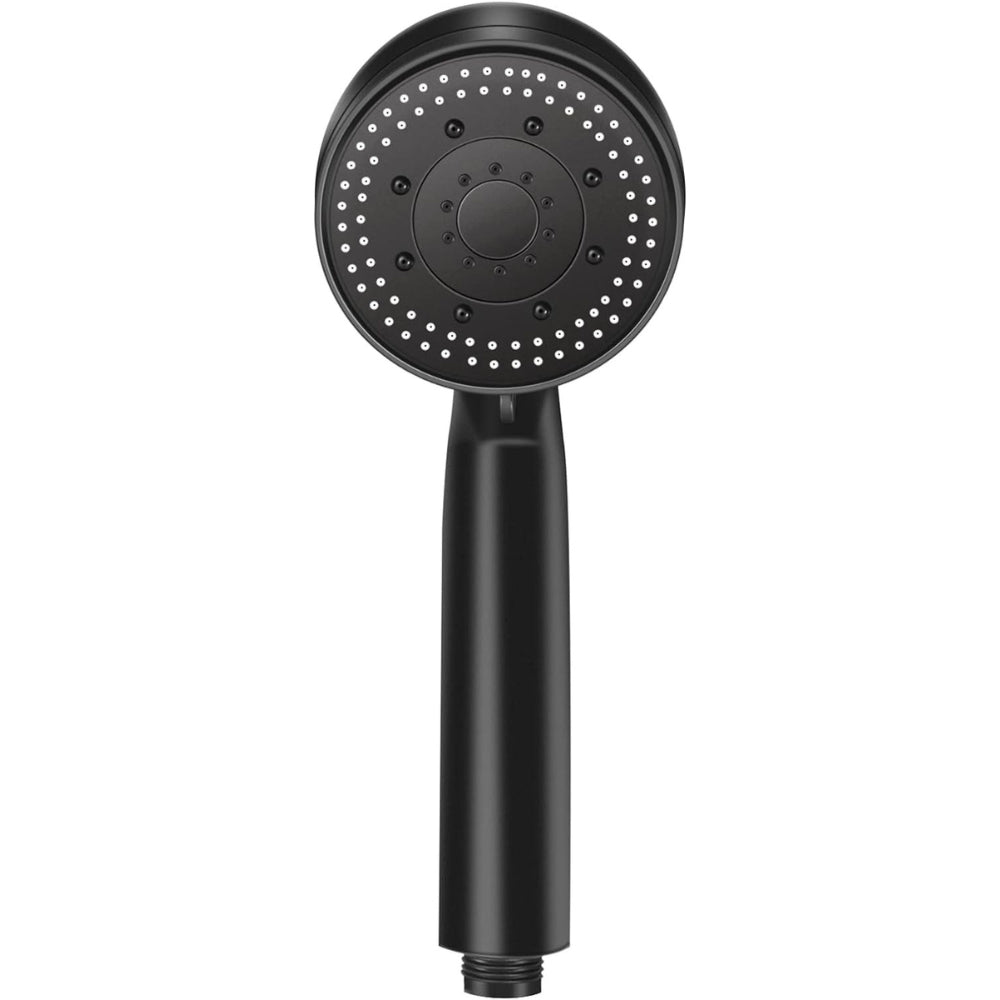
To clean a shower head, start by rubbing the soft silicone nubs with your fingertip or an old toothbrush: that is often enough. If it is still scaled up, soak it for one to two hours in white vinegar or hot water with citric acid added, then brush and rinse. One precaution: vinegar is an acid, and a matt black or gold finish does not tolerate it well.
If the jets stay blocked after two descaling sessions, or if the finish is flaking, it is time to switch to an anti-limescale shower head, whose soft nubs clean without any product.
The signs that a shower head is scaled up
- jets that go off at an angle or fan out;
- pressure that drops even though the tap is fully open;
- whitened or hardened nubs, and half-blocked holes;
- white marks that keep coming back on the face of the shower head.
Limescale builds up with every shower, when the water dries in the nozzles. The harder your water, the faster it comes back: it is the colour of the nubs, not the calendar, that tells you when to start again.
Step 1: cleaning without any product
Run the hot water and rub the nubs with your fingertip or a soft toothbrush: fresh limescale comes off the soft nubs. On several of our shower heads, the product page says it in one sentence: a swipe of the finger is enough to clear the jets. Then wipe the face with a soft cloth and soapy water.
This is also the care our product pages ask for on the finish: soft cloth, soapy water, and no acidic, chlorinated or abrasive product.
Step 2: descaling a shower head by soaking
Without taking it off: the vinegar bag
Fill a freezer bag with white vinegar, neat or diluted with a little hot water. Immerse the head of the shower head in it and tighten the bag around the handle or the arm with an elastic band. Leave it for one to two hours, remove it, brush the nubs and run hot water for a minute to flush out the residue.
Taking it off: the bath
Unscrew the shower head from its hose by hand, or with pliers, protecting the nut with a cloth. Soak it in a bowl of white vinegar and hot water, or hot water with citric acid, for one to two hours. Brush, rinse, then screw it back on, without forgetting the flat washer of the fitting.
Vinegar or citric acid?
Both dissolve limescale. Citric acid does not have the smell of vinegar; vinegar is already in the cupboard. In both cases, limit the contact time and rinse well: it is the acid that does the work, and it works on the finish too.
Depending on the material: what your shower head tolerates
| Material or finish | Recommended cleaning | To avoid |
|---|---|---|
| Soft nubs or silicone nozzles | Finger or soft brush, hot water | Metal point in the nozzles |
| Chrome-plated ABS plastic | Soft cloth; short acid soak as a last resort, rinsed straight away | Scouring pad, abrasive powder |
| Matt black | Soft cloth and soapy water | Vinegar, acid, chlorine: they dull the coating |
| Gold | Soft cloth and soapy water | Prolonged acid soak |
For a matt black finish, the product page of our black anti-limescale shower head (€29.90) is explicit: avoid any acidic or chlorinated product, as that is what dulls a matt black coating. On this model, you clear the nubs with a finger and leave the vinegar aside.
And the fixed shower head?
A large shower head on the ceiling or wall does not always unscrew easily. The bag method works here too, with a bigger bag held by string around the arm. For a very wide rain shower, a soaked cloth placed over the nozzles then a brushing does the same job zone by zone. The replacement models are in the shower head collection.
When to replace the shower head rather than descale it
Replace it if the nozzles stay blocked after two descaling sessions, if the silicone nubs are split or hardened, if the finish is flaking, or if the shower head leaks at the joint with the hose despite a new washer. A shower head is replaced without tools: it screws on by hand to the hose.
Before buying, check the thread: the models mentioned here state a 1/2 connection on their product page. The white handset with self-cleaning silicone nozzles (€41.90) is made of ABS, with three spray modes, and screws by hand onto the hose.
For a simple replacement, the universal anti-limescale shower head (€9.90) is made of ABS, 1/2 connection, with anti-limescale nubs.
All our models, handheld or fixed, are brought together in the shower head collection. To choose according to the pressure of your installation, see our guide on how to choose a shower head, and for fitting compatibility, our article that answers the question is a shower head standard.
The questions we get asked most
How do you remove limescale from a shower head?
First mechanically, by rubbing the nubs; then, if the deposit resists, by soaking for one to two hours in white vinegar or diluted citric acid, checking that the finish tolerates it.
Does bicarbonate of soda remove limescale?
On its own, it acts mainly as a mild abrasive: it helps with rubbing, but it is the acid, vinegar or citric acid, that dissolves limescale. Avoid rubbing a black or gold finish with an abrasive paste.
How do you take off the shower head?
It unscrews by hand, anticlockwise, at the fitting with the hose. If it resists, take pliers with a cloth around the nut so as not to mark it, and keep the flat washer for refitting.
Do you need to clean an anti-limescale shower head?
Yes, but more simply: its soft nubs clean with a finger. It does not remove limescale from the water; its nubs only let you lift the deposit off without any product.
