
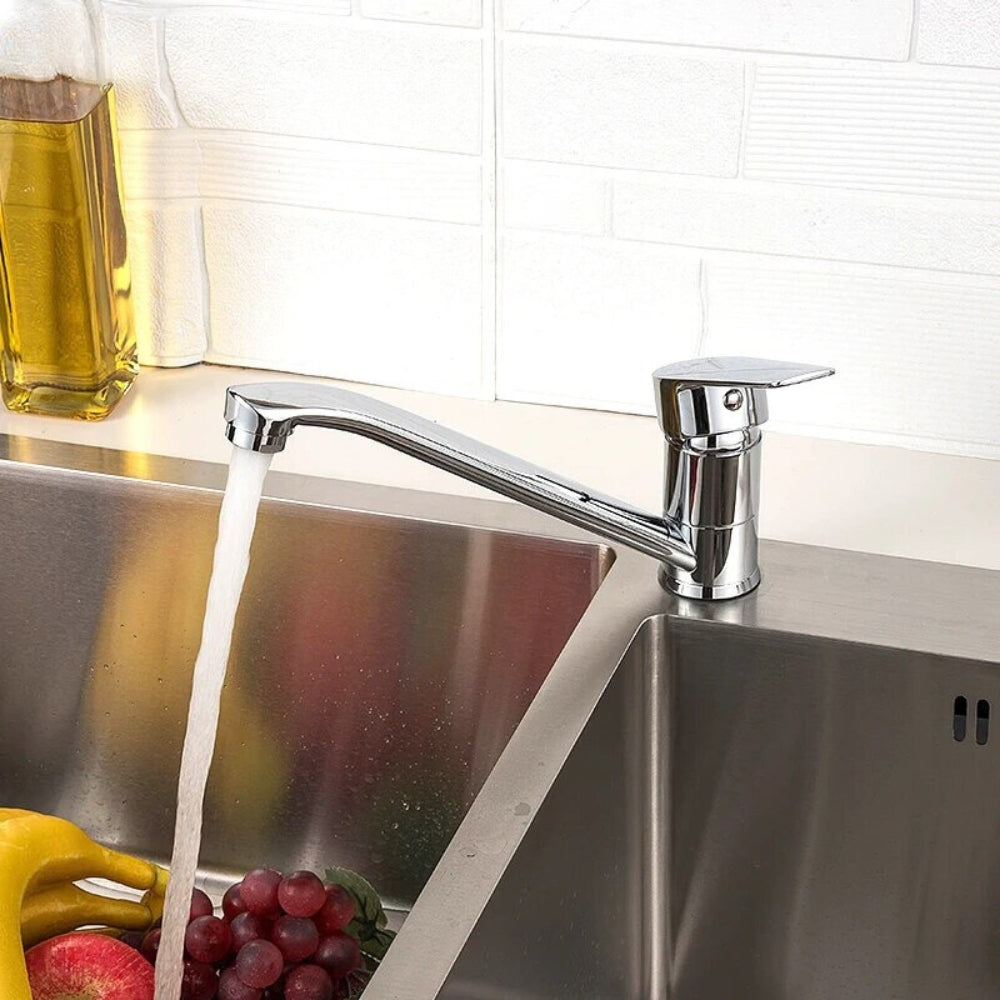
A tap that drips from the spout when closed almost always has a worn sealing part: the cartridge on a mixer tap, the valve washer on a two-handle mixer. A leak at the neck, at the base, under the sink or at the wall has another cause. So first locate the exact place where the water comes out, then turn off the water and change only the part at fault.
The diagnosis is the same for a kitchen mixer tap as for a bathroom tap: it is the location of the leak that points to the part, not the room of the house.
Finding where the leak comes from: the table by symptom
| What you see | Part most often at fault | The fix |
|---|---|---|
| The spout drips when closed (mixer tap) | The cartridge | Replace the cartridge with an identical one |
| The spout drips when closed (two handles) | The valve washer, or a scaled-up seat | Change the washer on the leaking handle |
| The tap leaks at the neck or base when open | The O-rings of the spout or body | Take off the spout and change the O-rings |
| Water under the sink or under the basin | A hose or a fitting nut | Retighten, then change the washer or the hose |
| The jet sprays sideways at the end of the spout | The scaled-up aerator | Unscrew and descale it, or replace it |
| A shower mixer leaks at the wall | The washers of the nuts on the fittings | Take the mixer off and change the washers |
Wipe the whole tap dry and wait a few minutes with a dry piece of paper under each fitting: the first drop that appears tells you where to look. A leak that only shows when the tap is open comes from the neck or the base; a leak that carries on with the tap closed comes from whatever is meant to stop the water.
First of all: turn off the water and drain the tap
Close the isolation valves under the sink or basin. If there are none, turn off the mains supply. Then open the tap to drain the water left in the pipes, and put a cloth at the bottom of the bowl: a screw dropped down the plughole is quickly lost.
Mixer tap leaking from the spout: the cartridge
On a mixer tap, the lever operates a cartridge that doses and shuts off the water. When it wears or scales up, the mixer drips when closed, or the lever gets stiff. The fix: remove the coloured cap, unscrew the lever screw, then the nut holding the cartridge, and take it out.
Take the old cartridge with you to find an identical one: the diameter, height and shape of the stem change from one model to another. We do not sell cartridges or washers individually: a hardware shop or plumbing merchant sells them singly. If the cartridge cannot be found, replacing the whole mixer often becomes simpler. The signs of a mixer at the end of its life are detailed in our article on the signs that a mixer tap is faulty.
Two-handle mixer: the valve washer
On a two-handle tap, each handle shuts off the water by pressing a small washer onto a seat. The tap drips when this washer hardens or when limescale stops the valve from pressing properly. Spot the handle that leaks (hot or cold), unscrew it with a spanner, change the washer and clean the seat. The step-by-step method, with the tools, is in our guide on changing a kitchen tap washer.
Tap leaking at the neck or base
A tap that leaks at the neck loses water at the junction between the spout and the body, especially when you swivel the spout. It is the O-rings, those rubber rings around the foot of the spout, that have dried out. You remove the spout by pulling it upwards after loosening its locking screw, change the O-rings with ones of the same diameter, and grease them with silicone grease before reassembling.
Water under the sink: hoses and fittings
A puddle in the cabinet does not always point to the tap. Follow the two supply hoses: a loose nut is retightened by a quarter turn, a crushed fibre washer is changed, and a swollen or rusty hose is replaced completely. A hose that weeps where it leaves the tap is changed with the tap taken off from underneath.
Spraying jet: the scaled-up aerator
When the water leaves in several streams or sprays to the side, the tap is not leaking: it is the aerator, at the end of the spout, that is blocked by limescale. Unscrew it by hand, rinse the mesh and leave it to soak to dissolve the deposit. If it is damaged, a new tap aerator screws on in its place; the collection has ten, from the water-saving aerator to the hose-pipe adapter.
Shower, toilet, outdoors: the special cases
Shower mixer leak
A shower mixer that drips from the spout comes down to the cartridge, as in the kitchen. If it leaks at the wall, it is the washers on the nuts holding it onto its fittings. The full removal is explained in our guide on replacing a wall-mounted shower or bath mixer.
Leaking toilet tap
On a toilet, the leak most often comes from the isolation valve or the cistern hose fitting. Choosing the washer according to the location is detailed in our article which washer for a toilet tap, and the replacement models are in the toilet tap and 3-way tap collection.
Leaking outdoor tap
Outside, a leak that appears in spring often comes from winter frost: a split body cannot be repaired. If the body is sound, you change the washer; otherwise you change the whole tap, which we detail for the replacement of an outdoor tap and its connector. The models are in the outdoor tap collection.
Repair or replace the tap?
Repair when the leak comes from a part you can find in an identical version: washer, cartridge, aerator, hose. Replace the tap when the body is cracked or corroded, when the cartridge no longer exists, or when the same leak returns despite a new part.
If you replace, first check the type of fitting (single-hole, two-hole or wall-mounted) and the size of the connection. In the kitchen, the small kitchen mixer tap (€49.90) is a single-hole model whose product page states a ceramic cartridge and a 1/2 connection.
At the basin, the bronze-finish basin tap (€59.90) is a single-hole mixer with the same 1/2 connection, also with a ceramic cartridge.
The questions we get asked most
Why does my tap still run after I close it?
Because the part that is meant to stop the water no longer closes: the cartridge on a mixer tap, the valve washer on a two-handle tap. Tightening the lever harder fixes nothing and damages the seat.
What should I do if my tap leaks at the head?
On a two-handle tap, water coming out under the handle comes from the gland packing or the O-ring of the head. Turn off the water, unscrew the head and change its seals; on a mixer tap, a leak under the lever points to the cartridge.
Can you repair a leaking mixer tap without taking it apart?
Only if the problem is at the aerator, which unscrews by hand. A worn cartridge cannot be repaired from outside: you have to remove the lever to change it.
How do you look after the tap after the repair?
A soft cloth and soapy water, then wipe dry. Our product pages advise against acidic, chlorinated or abrasive products on the finish; descaling is done on the aerator once removed, not on the chrome.
